We caught the 6:30 city train from Hösel to Essen and then the ICE bahn (fast train) from Essen to Berlin. The Essen train station has good pretzels. In Berlin we took an S-Bahn (stadtbahn=city train) to our hotel only a very short walk from the Ostbahnhof (East Train Station) in the former eastern zone. We stayed at Ostel, the DDR Hotel. A Trabi, the notoriously unreliable East German car, was parked outside.
  The place is a hostel but it also has private rooms. Our room is fairly large for a hotel and is clean and comfortable.
  We even have a sofa and a table.
  The furniture style is similar to the furniture in the House on the Embankment (huge apartment complex we toured across from the Kremlin in Moscow.) The building from the outside looks like the typical Russian apartment other than the bright colors and not being run down.The hostel takes up only a small area; the rest contains apartments and shops. In the middle is a huge courtyard with a sitting area and a playground.
The signal for walking across the intersection in East Berlin is the Ampelmann, green and beckoning when it is safe; red with arms outstretched when it isn’t safe.
As soon as we dropped our stuff off, we took the s-bahn back to the main train station and then hopped on a train to Wittenberg, the city where Luther lived. It was cold and rainy, but wasn’t raining hard enough to use the umbrella. We walked from the main train station to Lutherhaus, where Luther had taught when he was a monk.
 The university gave the house to him when the church separated.
  He lived here when he married. The living room was left as it was in Luther’s day.
 This is where the talks around the dinner table took place.
 Peter the Great had signed his name over the door.
  On display was a copy of Tetzel's coffer.
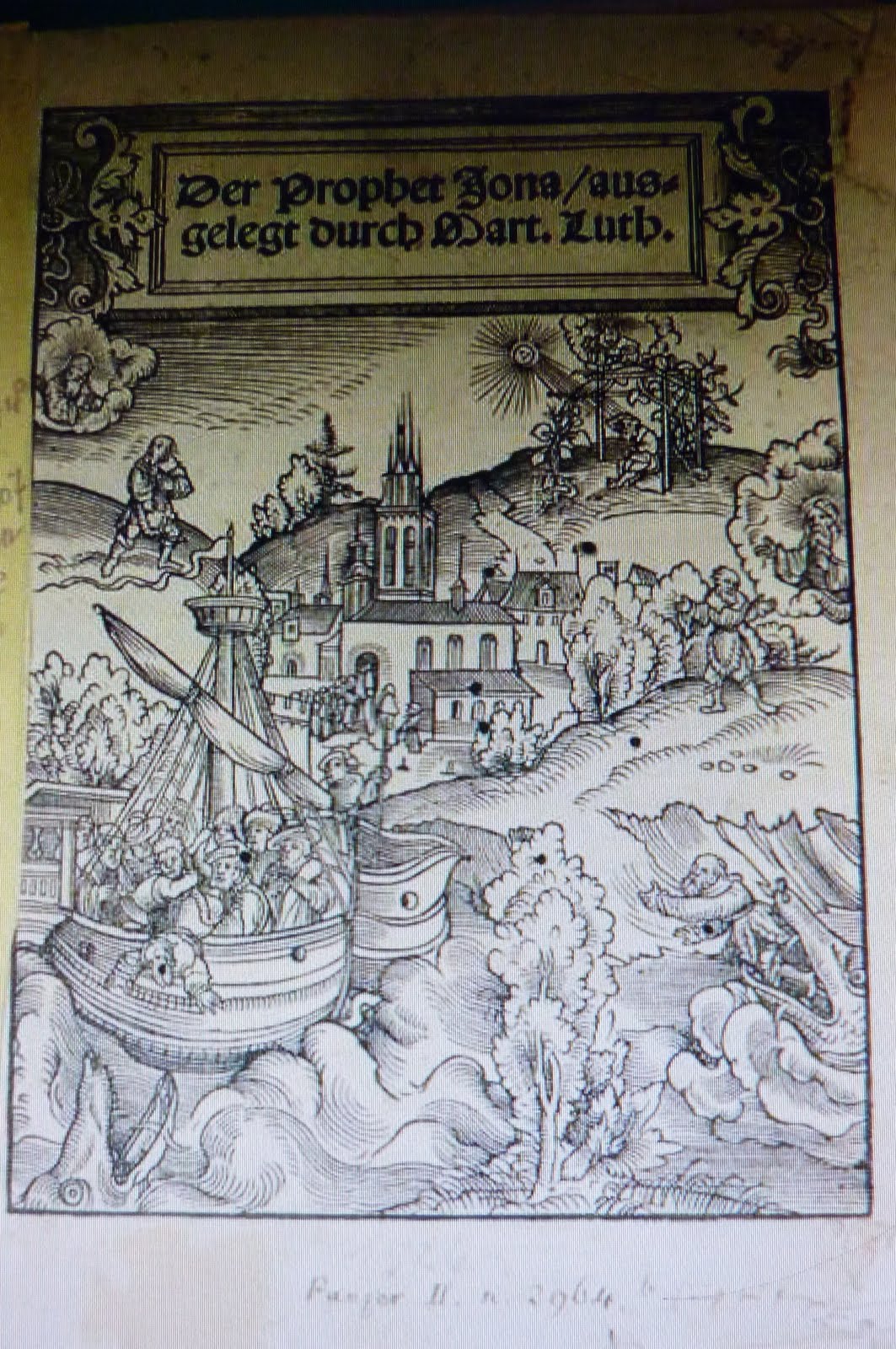
  We saw originals of the books when Luther had written and the bible he had translated. The famous painter Cranach the Elder had also lived in Eisenach and had illustrated many of Luther’s pamphlets and the bible he had translated. (Shown here are the book of Jonah and a scene from the Apocalypse.)
After that we walked to the Schosskirche—the castle church where Luther had posted his 95 theses which in on the western end of the main street. 
 Inside are the tombs of Luther, Philipp Melanchthon, and Frederick the Wise. The wooden door he had nailed them to burned down in 1760, later replaced with an iron door with the theses sculpted in.
 We walked back to the center of the city past the Rathaus, the town hall on the main square with the statues of Luther and Melanchthon.
 It also contained a well built in 1559 which carried water downstream to 19 houses in the vicinity using hollowed tree trunks connected with iron.
 Behind that was a knit shop with some very nice woolen yarn. A bit further east was the Stadtkirche (city church) where Luther preached and where he was married to Katharine von Bora.


 After that we walked back to the train station past the grove of trees, the area where various papers including the papal bull denouncing Luther had been burned beneath an oak tree. We took the train back to Berlin Ostbahnhof (East Train Station) and went to bed early.